By John Nolan
Thomas was a child of clean, unwavering lines. His world had borders and predictable corners, a comforting geometry that few other people seemed to appreciate.
Most adults, especially his father, were a jumble of soft edges and confusing impulses. But the fish—the Marlin—was perfect.
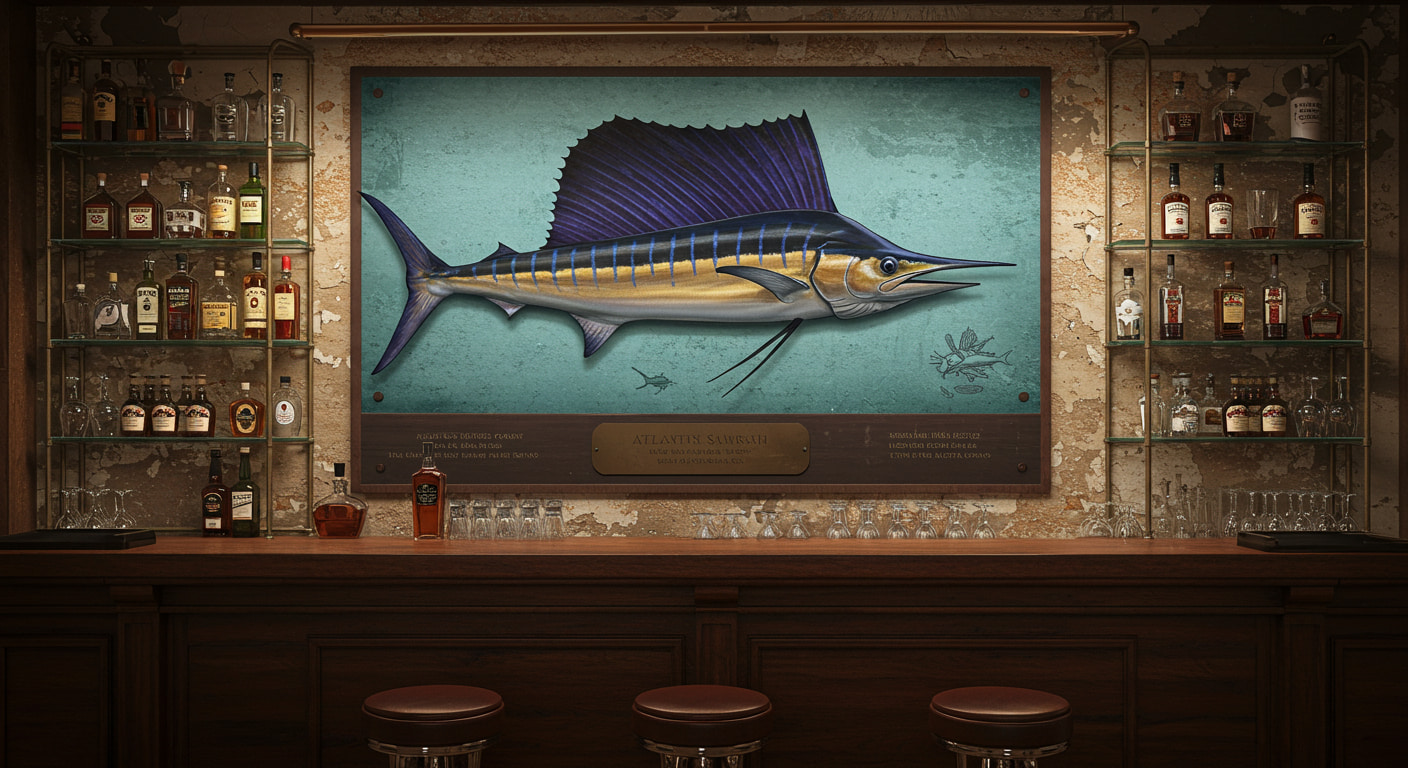
The Marlin hung above the bar, a plastic-cast trophy of a fish, frozen mid-leap. It was a cheap thing, its painted scales faded by a decade of stale cigarette smoke and sun-bleached afternoons filtering through the high, grimy windows of The Rusty Anchor.
The Marlin cost exactly $32.95 from a catalog, and every Friday for three years, Thomas had counted the silver push-pins holding its plaque to the fake wood paneling: there were seven.
The Rusty Anchor wasn’t a home, but it was their place. The only place.
His father was a man whose skin was perpetually red, like a sunset that had gone bad. He smelled of sweat and old beer, and he usually sat on the same cracked vinyl stool, his eyes tracing patterns in the condensation on his glass.
Not a bad father, not exactly. He just wasn’t present. But when Thomas was there, sitting on a high-top table stool, coloring in a notebook, the Marlin watched over them both. It was a silent witness, a stoic, scaly third party to their fragmented existence.
“He’s got eyes for that old fish again,” the owner, Pete, would chuckle, wiping down the bar.
Thomas would nod seriously, not taking his gaze off the plaque. “He’s an Atlantic sailfish, I. albicans, of the Istiophorus genus,” he would state. He liked the Latin. The Latin was solid. The Latin didn’t sway or slur its words.
“Sure, kid,” Pete would say, pouring another pint for his father.
This Friday was different. The air in The Rusty Anchor was heavy with a finality that Thomas felt, even if he couldn’t name it. His father took longer sips, and the usual noise of the place was replaced by the muffled echo of packing tape and the slide of empty boxes across the linoleum.
“It’s the last call, kiddo,” his Dad mumbled, setting his glass down.
“The Anchor is closing,” Thomas said, stating the fact. Pete had told him earlier, with a sad slump to his shoulders. The building had been sold to a developer. They were putting up apartments for the City-folk.
He nodded. “It is.”
Thomas looked up at the Marlin. It was the only memory they shared that didn’t involve the fuzzy, unpleasant feeling of waiting. If the bar went, the Marlin would go, and the seven push-pins holding up the one solid thing in his relationship with his father would vanish.
“Dad,” Thomas began, his voice tight.
“Can we… can we have the fish?”
Dad blinked, his eyes unfocusing for a moment. He followed Thomas’s gaze to the ceiling.
“That old piece of plastic? What for, Thomas? It’s junk.”
“It’s not junk,” Thomas insisted, sliding off his stool.
The words hung in the air, exposed and vulnerable. His Dad didn’t look at him. He stared at the reflection of the Marlin in the dark beer.
“No, kid. It stays with Pete,” his Dad sighed, pushing himself up. The motion was clumsy, not drunk, but weary. “Come on. Let’s go.”
A knot of panic tightened in Thomas’s chest. This was it. The absolute end. He was losing his anchor. He couldn’t leave. He wouldn’t. While his father was fumbling with his coat, Thomas darted behind the bar. Pete was busy struggling with a roll of bubble wrap and didn’t notice.
Thomas stood on his tiptoes on a discarded milk crate. The plaque was heavy, but the plastic fish was light. He jammed his fingernails under the wood and pulled, ignoring the sharp, stinging pain.
The first pin popped out with a loud twang. Then the second.
“Thomas! What are you doing?” his Dad’s voice was sharp.
Thomas didn’t answer. He was focused. He had to get the Marlin. It was the most important thing he had ever had to do. The third pin yielded, and the plaque tilted dangerously. Dad was hurrying towards the bar.
Thomas pulled hard, a desperate, final yank. The remaining four pins tore out of the dry paneling with a shredding sound that echoed in the empty room.
Thomas stumbled back, clutching the dusty plaque. The Marlin was his. He looked up at the gaping holes in the wood, then at his father. His face was a mixture of surprise and a strange, raw emotion that wasn’t anger.
Dad just stood there for a long moment, watching his son clutch the plastic fish like it was a relic. He looked from the Marlin, to the holes, to the boy. Then, slowly, his Dad reached out.
Thomas flinched, expecting a blow.
Instead, Dad’s large hand came down and gently, tentatively, brushed the dust off the Marlin’s plastic tail. “It’s a good fish, Thomas,” he whispered. He finally met his son’s eyes, and in them, Thomas saw a clarity he had never seen before. “It’s yours. Let’s go home.”
The bar was gone, the Marlin was saved, and his father, for the first time, was looking right at him. A hard-won piece of proof that even the most fragmented relationships could yield something solid and beautiful to hold onto.
●●●
Leave a Reply